Monday, October 31, 2011

Sydney Royal Botanical Gardens

Eels and bats...oh my...am I in Transylvania? Nope. I am in downtown Sydney.

Some of the best views of the Sydney icons are offered from the public gardens. The Sydney Royal Botanic Gardens is part of the original garden called the Governor's Domain.
In 1816, the land was set aside by the Governor of Sydney, Governor Macquarie. The huge number of things in Australia named Macquarie is a testimony to his governing (or his vanity). One spot in the park is named Mrs. Macquarie's Seat. She liked to sit, look out at the harbour, and watch the ships coming and going. Since he was Governor, he had a road built through the Domain just for her to get there. The seat is carved out of stone. It's good to be The Governor.

Just above this spot is one of the most photographed spots in all of Sydney (you would never know it because it is where people stand).

The viewpoint looks back on the Opera House with the Harbour Bridge backdrop. It is the PERFECT place to watch fireworks on New Years (if you can get there early enough). I did exactly that in 2001 when Australia celebrated its Centennial of becoming the commonwealth. It was an amazing spot but by noon, the place was packed.

The park is beautiful. It has expanded since the original Domain and now is over 30 hectares. Throughout most of the park you can see the skyscrapers of downtown Sydney just behind the trees.

The gardens can be accessed from several entrances including an easy walk from Circular Quay around the Sydney Opera House. It is open until around dusk and is free to enter. They even have daily free hour long walking tours. The tours are different depending on the guide, but most of the volunteers conducting the tour are quite good.

The plants include an herb garden, rose garden, palm house, Chinese garden, and natural indigenous plants. Every tour makes a point to stop at the Wollemi Pine. It is one of the world's oldest and rarest tree species belonging to a 200 million-year-old plant family. It had only been seen in the fossil record and was thought to be extinct. A grove of them were discovered in the mid 1990's by a botanist bushwalking in the Blue Mountains west of Sydney. Several specimens have been sent to protected parks to help ensure the survival of the species.

Among the most stunning sights are the Jacaranda trees in full bloom. The purple was so beautiful and vibrant.  The other show-off is the yellow wattle.  The yellow poof balls are all over the tree (pictured above).


The tall, proud Norfolk Pines are also scattered through the park. These trees were imported from Norfolk Island (a Pacific island east of Australia, between New Caledonia and New Zealand). Captain Cook thought that the trees would make excellent ship masts, as their trunks are so straight and tall. This was not the case but their distinctive features are great for marking harbour entrances. They are scattered throughout the South Pacific.

I love the Queensland Bottle Tree. There is an aboriginal story about the tree. The legend goes that the tree was a beautiful tree, but was vain. The tree would flaunt its beauty to all of the other trees around. The gods warned the tree to stop. The tree ignored the warnings. So the gods came down and uprooted the tree, turned it upside down. The bottle tree has remained with all of its roots in the air.


The gardens are full of animals. Sulfur-Crested Cockatoos are found in droves. They crunch on seeds and nuts. And they are LOUD. You hear a flock of cockatoos before you can see them. They are constantly screeching at each other and jostling. It is a lot of fun to see them display their crest of yellow head feathers.

The other bird frequently seen in the garden is the Australian White Ibis. The ibis are strange looking birds. They have long, thin, curved beaks. They are much quieter than their compatriots but also can be cheeky.

One of my favorite discoveries was the ponds with ducks and eels. We were told that the ponds are emptied out occasionally for cleaning. The eels are removed and relocated. The park workers have seen new eels slithering across the grass from the harbour back to the pond. Yep, they can actually move across land to get to their desired destination. Fascinating. I laughed at the plaque beside the pond that describes how natural it is for a cuddly duckling to become an eel meal.

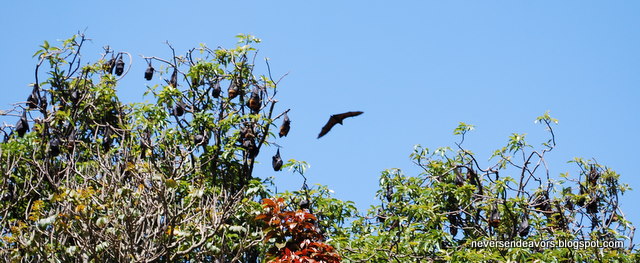
It is strange to think of bats in a park in a major city.  There are hundreds of fruit bats (or flying foxes) in the trees. Unfortunately, they are damaging the trees since they are not leaving for their normal migration. So the trees never recover. I guess they have decided that they like the views from the garden as well.

The sandstone in the park has been carved out over time creating beautiful spots to sit. The Sydney Royal Botanic Garden is a great place to read quietly, go for a walk, or picnic with friends.
It is a favorite Sydney destination and a must see when visiting..

Tuesday, October 11, 2011

Mozart's Don Giovanni - Sydney Opera House

Picture from Don Giovanni article
from Sydney Paper
It is always a good sign when an opera opens with an incredibly muscled man jumping out of a window wearing skimpy black leather shorts and an open shirt. Then he opens his mouth and a deep, huge, booming baritone voice fills the entire theater...it was like butter. Oh my...a six pack with butter.

We saw Mozart's Don Giovanni at the Sydney Opera House. It was stunning. One of the best operas I have ever seen.

Don Giovanni is a character that you love to hate. He is a gallivanting, narcissistic cad who preys on women...literally thousands of women. In the opening scene, he gets in trouble when he is challenged by a girl's father who he ends up killing in the duel. Instead of going away to another unsuspecting female pool in another country, he stays in the same area. He is hunted by an ex-lover after making his presence known to her by propositioning her inadvertently. She is torn as she is still captivated by him but knows he is no good. Then he aggressively pursues another woman on her wedding day by neutralizing her groom. The betrothed of the girl whose father he killed vows revenge to prove his love. For those keeping score at home, that is a soprano, a mezzo-soprano and an alto (three female leads) and two fiancées (a baritone and a very high tenor) all out to get Don. Not to mention Don Giovanni's own manservant who does not like him either. In the end, a statue of the father he killed in Act I raises the powers of darkness to come and drag Don's soul into the depths of hell.

 Mozart really knew how to write music. The score is great. It has both intense music and melodic interludes. The vocal arrangements are stunning. Some scenes have 5 operatic leads all singing harmoniously together.

The voices were absolutely incredible in the Sydney production! Teddy Tahu Rhodes played Don Giovanni. He is amazing in this role!  With his powerful baritone voice and stage presence, he blew everyone else out of the water . The actor portraying Don Giovanni needs to be overpowering.  He is also competing with the other five leads. Teddy succeeded.

The remaining cast members were all extremely strong and powerful in their own right. Donna Anna was played by an Australian and lit up the stage. Zerlina's voice was beautiful. I could have listened to them all night. My other favorite was listening to the sweet tenor who played Don Ottavio (Henry Choo). His voice was so soft and sweet. Don Ottavio is shafted the whole show. I felt sorry for him. His voice reflects the tenderness of the character. Amongst such depravity, he is the only really sympathetic character in the play. 

They must have spent their entire budget on the vocal talent. The sets are fairly minimal with just a big space on stage with doors/balcony. But we did not go for the props. The show was fantastic with all of the full voices. The last scene was strangely blocked. Don Giovanni almost escapes from the hands of death (strapped to a coffin) and then gets grabbed a different way for no apparent reason other than to use the trap door in the stage floor. I guess they wanted to show off the one fancy part of the set. It is saved by the entire back part of the set crashing to the stage floor. Drama drama drama.

We sat in row Q on the floor and the seats were fantastic. Row Q is just about the best row in the house. The first ten rows are directly under the surtitles so you can't see them and the overhanging balcony obstructs the view from the last 4 or so rows. The sound is perfect. We were just right and not even any porridge spilled.  There was, however, some cooked chicken (and silverware and cups) flung across the stage in the second act when Don Giovanni is acting like a slob. He's and eating and drinking as much as he is tossing around, and he's throwing anything he puts his hands on. But Row Q was outside the splash zone.

I have come to think that with La Boehme, Macbeth and now, Don Giovanni, that opera is all about plotting and death.

Thursday, September 22, 2011

Nature in the City

Sydney has been a fun city to live in. Unlike when I lived in North Queensland, there are significantly fewer opportunities for animal interactions in a big city. In Townsville, we had little geckos in our house daily. I missed the sound of their calls when I moved.

In the more temperate city, birds are more prevalent. Ibis and seagulls were common to see everywhere in Sydney. The botanical gardens were full of flying foxes (bats) and the loud cacophony of the sulfur crested cockatoo which were fun to see in the middle of a city.

We lived on the 7th floor of a high rise building. It was normal to have bird visitors on the ledge outside of our building. The lorikeets were my favorite. They were so brightly colored with bright blue heads, rich red beaks, green backs and stunning yellow chests. They tended to visit in pairs.
Rainbow Lorikeet in Sydney
One morning I heard very loud squawk...louder than normal. I moved the curtain over our window and saw that one had come in and was on the inside of the window and was talking to his partner on the outside of the window. They were trying to figure out why they were not able to be next to each other. I left the curtain closed and he eventually found his way out.
He was so much nicer than the magpies that came into visit.

My not-so-plesant visitor came on multiple occasions. I was sitting in our apartment in Sydney. I opened the window because it was a beautiful day and I wanted the airflow. A magpie came into the cracked window and flew into the apartment. He landed on the kitchen counter, looked around, pooped, and flew out. I learned that I needed to close the windows when I left. This happened 3 or 4 times. I did not appreciate the gifts left.
Sydney is full of birds. The Australian White Ibis and seagulls were commonplace. The ibis are not like the common birds I am used to.  They are white birds with black heads and a long, curved black beak.
The whip bird was not common to see but was fun to hear. It has an amazing sound. The song started as a high pitched sound that grew louder and louder and louder in a crescendo. Then the song would drop off suddenly. The effect was like a beautiful whistle whip cracking.

Out walking in any park or forest area, it was normal to hear the laugh of the kookaburra. I love the sound of kookaburras.  Their sound is so much fun and makes me smile.

Nature in the city is fun especially if it stays OUTSIDE.


Sunday, September 18, 2011

Grampians National Park, Victoria

The Grumpies!
Matthew and I went to hike in the Grampians National Park in western Victoria. Three hours from Melbourne, it is a great location for a weekend away. September/October is the height of the wild flower season in Australia.
The Grampians is home to such fantastically named places as Flat Rock, Mount Zero, Mount Abrupt, and Mount Difficult. Whoever named some of these places had no naming ability or a quirky sense of humor.

The Grampians themselves are a range of big, old mountains that sit on a totally flat plain. They rise up out of an otherwise featureless expanse of flat. There are not really even hills leading up to the Grampians. It is just flat and then mountains.

The drive out to Halls Gap (the gateway town to the Grampians) from Melbourne is not very exciting. It is 3 hours across a plain with farms and some scattered gum trees. We drove it at night, so it was even less exciting. The only indication that we were getting closer was that the houses were more and more sparse and the trees were more and more dense.

Halls Gap is quite small. We were able to walk from one end of the town to the other in less than 30 minutes. It has places to sleep, a couple restaurants (most on the expensive side) and some little shops but not much else along the single main road.  We stayed at Ted's Beds which worked well for us. Ted is a really nice guy who loves what he does. We were given the Grand Tour and he recommended some hiking options. Several of the trails were only minutes from our room. Great location!
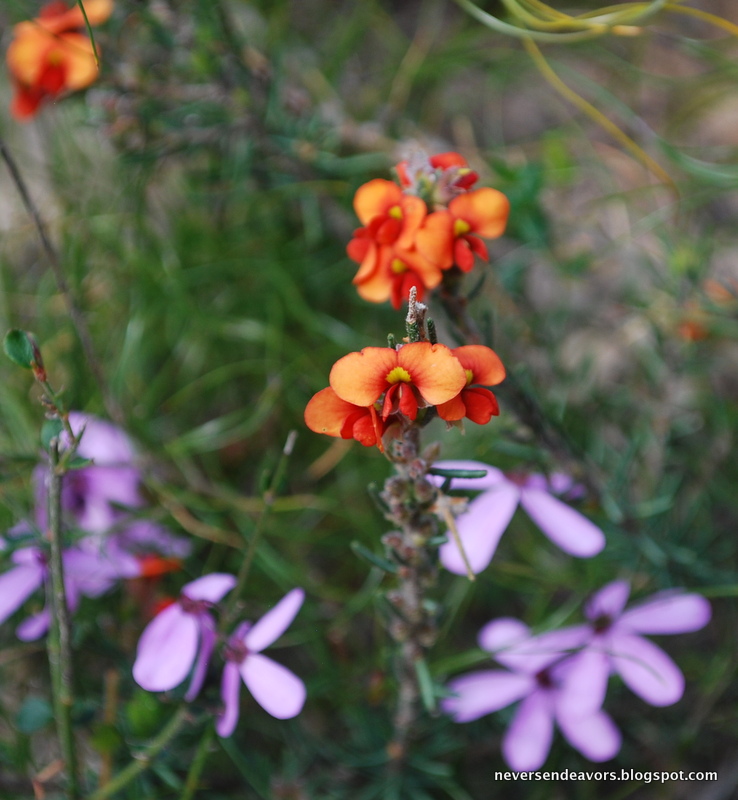
Orange flower is the Parrot Pea
(Dillwynia Sericea)
Showy Parrot Pea (yellow)
Pink flower is the Leafless Bitter Pea
(Daviesia Brevifolia)

Like all the other guests at the hostel, we had come to hike and see wildflowers. Boronia Peak was one of the hikes Ted had suggested. It was listed as a 3 hour return trip up to a peak with good views of the area. The path was beautiful with all of the different little wild flowers. The flowers were all very small but they littered the landscape creating a collage of colour. It was impressive.

The most prolific were the species of pea flowers. The flower is very small. We thought they were a small orchid at first. The peas came in a wide variety of colors, stem and leaf types. They were among the most striking due to the shear quantity in the forest.
Variable Prickly Grevillea (Grevillea Aquifolium)Sasparilla Vine (Hardenbergia Violacea)
Water Wattle (Acacia Retinodes)Grampians Thryptomene (Thryptomene Calycina)
Cat Claws (Grevillea Alpina)Guinea Flower (Hibbertia fasciculate)

Flower Variety
Matthew liked the Grevillea. It is such a different shaped flower than we had seen before. It was also larger than the rest of the little wild flowers. He also liked the Cat Claws because they were so unique.

My favorite was the wattle. The flower is a little poof ball of bright yellow. They just look happy.


I also loved the fuzzy flowers.


Along the walk I found several places where one lone flower was sticking up out of the most impossible place including out of rocks or on a cliff. It was the poster flower for a motivational poster labeled something like "Persistence...growing in spite of the odds".
The lower part of the walk was filled with wildflowers. The lower forest gave way to rocks...large rocks. The upper part of the walk consisted of climbing over and around large boulders that formed high plateaus and deep crevices. It was important to keep a good footing on this part of the hike. They were the type of rocks that yearned to be climbed on.

It took us longer to hike than 3 hours, mostly because we had to stop to photograph flowers along the way and climb on the rocks at the top. We found a great place to eat a snack at the peak.
The view at the top was spectacular and offered 360 degree vistas. It felt like we were at the top of the world. The valley below was flat and lead to a lake. The side of the surrounding hills went straight up. From where we were, we watched the tiny miniature trucks moving up and down the road.

After our first hike, we walked the other way across a different street from Ted's to do the Climatis Falls hike. On the way we passed a cricket pitch that was fully fielded. I am sure they had too many players on the field.
The kangaroos had moved in for a game but their game was eating grass and relaxing. The field was full of over 50. Kangaroos have such powerful muscles. I enjoyed watching the joey poking out of his momma's pouch. We also saw one rolling around the ground on his back like a big dog scratching himself. It was funny to see a kangaroo lying on his back.
Kangaroos fielding Cricket Pitch

The waterfall was disappointing; not worth the very easy walk. There was barely more than a dribble of water. We did find a side trail that was fun. It was the start of a much longer hike. We found a great rock outcrop that was flat.  A perfect spot to watch the sunset to the sound of a laughing kookaburra.
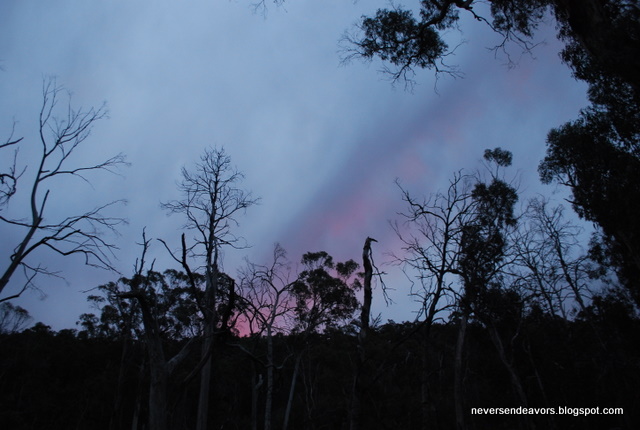
The sunset that evening painted the night sky with beautiful pinks and purples in the wispy clouds. It was like an artist brushed the sky with watercolor paint on the blue canvas.

The next day we drove around to some of the better known falls.

MacKenzie Waterfall is one of the highlights of the Grampians. We were underwhelmed. It was a nice waterfall but nothing to write home about...or blog about. They divert a large percentage of the water.  Even with all the rain this year, the water was not really flowing. The water is eroding the earth so they say they are decreasing the falls "moving backwards" by diverting water. Sounded like justification to do what they wanted to do as all moving water wears away the earth it moves over.

We also drove to the popular Reed Lookout / The Balconies and the Pinnacle Lookout.
The Balconies Lookout

The Reed Lookout and The Balconies are at the same place, just two different vistas. The Reed Lookout gives a panorama of the valley over to the Mount Difficult Mountain Range. The Balconies lookout off to another side of the valley. It has rocks that are in the shape of a Muppet character. This creature surveys the beautiful valley from on high.  Pinnacle Lookout was also impressive.  The lookouts were all spectacular.

On the way to the last hike of the day we saw fields of mustard. The striking bright yellow was magnificent. There were several fields of blooming mustard around the Grampians.

My favorite hike of the day was Hollow Mountain. The trail was amazing. If you do not like bounding over smearing yourself down between two rocks, bounding over boulders, or heights...this is not the hike for you. It is short hike up (and I mean straight UP) that offers a magnificent view of the Mount Stapylton Range and the surrounding Wimmera Plains.


Hollow Mountain is popular among rock climbers as a safe place to practice ....because of the large open crevices on the mountain (hence the name Hallow). At the top, it is easy to see the flat expanse of plains that is disrupted by the rise of Hallow Mountain and Mount Stapylton. This contrast of the mountains in the otherwise flat farmland landscape adds to the drama of the place.


I really liked the Grampians.

On the way back to Melbourne, we saw the giant fiberglass koala.  He is pretty scary.

Tuesday, September 13, 2011

Verdi's Macbeth - Sydney Opera House

After our success with La Boheme, we decided to try for rush tickets to Macbeth at the Sydney Opera House.  It was showing on a Tuesday night and luckily it was a VERY slow night at the Opera House.  Normally when you buy standing room tickets, you expect to stand.  But since about half of the upper deck was empty, we were able to sit in the balcony about 9 rows back. YEA!
At intermission we moved down to row 3.  We were surprised at how big of a difference the 6 rows made in the view and the sound...we felt so much closer even though the original seats were fabulous.

Bubble bubble toil and trouble...

For those of you who slept through high school English, Macbeth is Shakespeare's classic story of a power hungry man who becomes Scotland's king by the traditional means...regicide.  The story includes his equally power hungry wife who goads him into the murder when he begins to lose his nerve.  One killing leads to many many more.  And how can a story be made better...yep...a coven of witches.  The original play has just three, but this production had an entire coven divided into three groups.

We knew nothing about the actual score, but Verdi's music was so much better than we expected.  It helped the story progress and was interesting.  It had some truly dramatic moments and flowed really well.  No symphonically induced napping.

The voices were incredible. Lady Macbeth and Banquo were both outstanding.  Although the leads had magnificent voices, the big stand out was, surprisingly, a more minor character, Macduff.  His mellow voice was a high baritone or low tenor with  a fabulous tone.  He did not get much stage time, but he he stole every aria he sang and ended up getting a huge round of applause at the end.  He actually seemed quite surprised by this.  
Note that seeing the opera won't help anyone struggling with Shakespearean English because it is all sung in Italian.

It was a nice night out. Is that wrong to say that for a show all about murder?